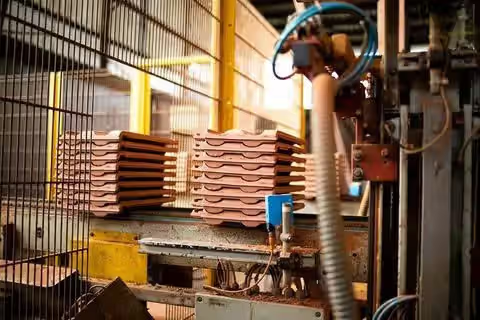
Industrial Brick Machine Basics in Automated Construction Systems
Learn how industrial brick machines work, why they matter in construction, recent trends, regulations, and key tools shaping modern brick manufacturing.
Modern brick-making machines have evolved significantly — integrating automation, hydraulics, and digital control systems — making production faster, more sustainable, and less labor-intensive.
Whether producing clay, fly ash, concrete, or cement bricks, these machines are designed to shape, press, and cure materials into uniform blocks used for residential, commercial, and industrial projects.
Importance
The use of industrial brick machines has transformed traditional brick production methods, improving efficiency, sustainability, and quality control.
Why They Matter
-
High Production Efficiency: Capable of producing thousands of bricks per hour.
-
Cost Reduction: Reduces labor and material waste through precise molding.
-
Consistency: Ensures uniform size, shape, and strength for every brick.
-
Environmental Benefits: Many models support eco-friendly materials like fly ash and recycled aggregates.
-
Automation and Precision: Reduces human error and speeds up mass production.
-
Durability: Mechanically compacted bricks have superior structural strength.
In modern construction, using brick machines contributes to faster project completion, reduced carbon footprint, and higher quality standards.
Recent Updates
Advancements in automation, hydraulics, and digital monitoring have significantly enhanced the capabilities of industrial brick machines.
Key Industry Trends (2025–2026)
-
Automation & AI Integration: Smart sensors and IoT systems optimize production parameters automatically.
-
Hydraulic Systems: Offer higher pressure and uniform density for premium brick quality.
-
Eco-Friendly Machines: Adoption of fly ash and soil-based models that minimize environmental impact.
-
Modular Design: Allows quick switching between different brick sizes and patterns.
-
Energy Efficiency: Use of energy-saving motors and curing systems to reduce power consumption.
-
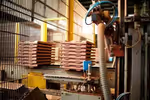
Robotic Handling Systems: Integration of robotic arms for automatic stacking and packaging.
-
Market Growth: The global industrial brick machine market is projected to reach USD 3.8 billion by 2030, with steady adoption in Asia-Pacific and Africa.
These innovations reflect the shift toward sustainable, smart, and automated construction manufacturing.
Laws and Regulations
Industrial brick machines are subject to safety, quality, and environmental standards to ensure efficient and compliant operations.
Key Regulatory Areas
-
ISO 9001: Quality management certification for manufacturing consistency.
-
ISO 14001: Environmental compliance for sustainable production.
-
BIS Standards (India): Bureau of Indian Standards ensures proper material composition and strength for construction bricks.
-
OSHA Guidelines (USA): Ensures worker safety and operational safety in automated machinery.
-
Emission Regulations: Machines using clay or coal-based processes must comply with air pollution and emission norms.
Complying with these standards guarantees safe operations, product reliability, and environmental responsibility.
Tools and Resources
Professionals, engineers, and entrepreneurs can leverage various resources to operate, maintain, and optimize industrial brick machines effectively.
| Category | Tool / Resource | Purpose / Use |
|---|---|---|
| Design & Simulation | AutoCAD, SolidWorks | Machine and plant layout design |
| Automation & Monitoring | PLCs, SCADA, IoT Dashboards | Process control and data analytics |
| Quality Testing | Compression Testers, Curing Chambers | Brick strength and durability testing |
| Training & Courses | Coursera, edX, Skillshare | Learn automation and production optimization |
| Manufacturers | Lontto, Hydraform, QGM Zenith | Reliable global brick machine suppliers |
Helpful Tips
-
Choose Machine Type Wisely: Match your machine type with your raw materials (e.g., clay, cement, or fly ash).
-
Automate Gradually: Start with semi-automatic systems before scaling to full automation.
-
Regular Maintenance: Keep hydraulic systems and molds clean for optimal performance.
-
Ensure Proper Curing: Use controlled temperature and humidity for stronger bricks.
-
Train Operators: Well-trained staff can prevent downtime and reduce errors.
Types of Industrial Brick Machines
| Type | Key Features | Common Applications |
|---|---|---|
| Manual Brick Machine | Low-cost, human-operated press | Small-scale rural projects |
| Semi-Automatic Machine | Mechanized pressing and feeding | Medium-scale production |
| Fully Automatic Brick Machine | PLC-based, continuous production line | Large industrial facilities |
| Hydraulic Brick Machine | Uses high-pressure compaction | High-strength brick manufacturing |
| Fly Ash Brick Machine | Eco-friendly and low-emission | Green construction projects |
| Interlocking Brick Machine | No cement or mortar required | Low-cost housing solutions |
Each type caters to specific production capacities, material types, and operational budgets.
Industry Applications
Industrial brick machines serve a wide range of construction and infrastructure sectors.
-
Residential Construction: Building homes and low-rise structures.
-
Commercial Buildings: Producing uniform bricks for large projects.
-
Infrastructure Projects: Used in roads, bridges, and drainage systems.
-
Eco-Friendly Housing: Manufacturing green and interlocking bricks.
-
Export Manufacturing Units: Large-scale facilities producing bricks for international markets.
By automating production, these machines ensure higher efficiency, consistent quality, and reduced environmental impact.
FAQs
Q1. What is an industrial brick machine?
It is a machine that automates the process of forming, pressing, and curing bricks for large-scale construction use.
Q2. How does a brick machine work?
The machine mixes materials, fills molds, applies hydraulic pressure, and ejects uniform bricks for curing.
Q3. Which materials are used in brick making?
Common materials include clay, cement, sand, lime, and fly ash.
Q4. What is the difference between automatic and manual brick machines?
Automatic machines use hydraulic and PLC systems, while manual models rely on human labor for pressing and feeding.
Q5. Are fly ash bricks better than clay bricks?
Yes. Fly ash bricks are eco-friendly, lighter, and have higher compressive strength than traditional clay bricks.
Conclusion
Industrial brick machines have revolutionized the way bricks are manufactured — combining efficiency, sustainability, and precision. From manual setups to AI-driven systems, these machines cater to both small and large-scale construction needs.
By embracing automation, modern brick manufacturers can ensure cost-effective production, reduced labor dependency, and environmental compliance.
Whether you are a builder, investor, or engineer, understanding the mechanics, trends, and benefits of industrial brick machines provides a strong foundation for sustainable construction success.