Hydraulic Press Machines: Complete Guide to Industrial Applications and Uses
Hydraulic press machines are industrial devices that use fluid pressure to generate a compressive force. Based on Pascal’s principle, these machines multiply force through a hydraulic system, allowing heavy-duty operations with precision and control. They are widely used in industries such as metal forming, automotive manufacturing, aerospace engineering, and plastic molding.
The need for hydraulic presses emerged from the demand for efficient material shaping techniques. Traditional mechanical presses required more energy and offered less control. Hydraulic systems, on the other hand, provide uniform pressure distribution and adjustable force, making them suitable for delicate as well as heavy operations.
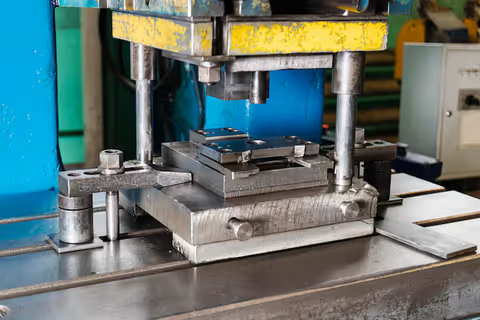
These machines exist to simplify processes such as forging, stamping, bending, punching, and molding. Their ability to handle high loads while maintaining consistency has made them a core part of modern industrial automation.
Why Hydraulic Press Machines Matter Today
Hydraulic press machines play a crucial role in modern manufacturing ecosystems. Their importance has grown due to increasing demand for precision engineering, mass production, and energy-efficient operations.
Industries rely on hydraulic presses to solve several challenges:
- Ensuring uniform shaping of materials
- Reducing manual labor and improving safety
- Increasing production speed and consistency
- Supporting complex manufacturing processes
They affect a wide range of sectors including automotive, construction, electronics, and packaging industries. For example, in automotive manufacturing, hydraulic presses are used to shape metal components with high accuracy, which is essential for vehicle safety and performance.
Additionally, these machines contribute to sustainability by minimizing material waste and enabling recycling processes such as metal compaction. Their adaptability allows manufacturers to switch between operations with minimal adjustments, improving operational flexibility.
Recent Updates and Trends in Hydraulic Press Technology
Over the past year (2025–2026), hydraulic press machines have seen notable advancements driven by automation and digital transformation.
One major trend is the integration of Industrial IoT (Internet of Things). Modern presses are now equipped with sensors that monitor pressure, temperature, and performance in real time. This allows predictive maintenance and reduces downtime.
Another key development is the adoption of servo-hydraulic systems. These systems combine hydraulic power with servo motors to improve energy efficiency and precision control. Many manufacturers have reported reduced energy consumption and enhanced operational accuracy with this technology.
Automation and robotics are also being integrated into hydraulic press operations. Automated loading and unloading systems have improved safety and reduced human intervention.
In 2025, several industrial automation conferences highlighted the shift toward smart manufacturing, where hydraulic presses are connected to centralized control systems. This enables better data analysis and process optimization.
Sustainability has also become a focus area. New designs aim to reduce hydraulic fluid leakage and improve energy efficiency, aligning with global environmental goals.
Laws and Policies Affecting Hydraulic Press Machines
Hydraulic press machines are subject to various regulations and safety standards, especially in industrial environments.
In India, regulations are governed by frameworks such as:
- The Factories Act, 1948, which mandates workplace safety and machine guarding
- Bureau of Indian Standards (BIS) guidelines for industrial machinery safety
- Occupational Safety, Health and Working Conditions Code (OSH Code), updated in recent years
These regulations require proper installation, regular inspection, and operator training to prevent accidents. Safety features such as emergency stop mechanisms, protective barriers, and pressure control systems are essential compliance requirements.
Globally, standards like ISO 16092 (Safety of Machine Tools – Presses) define safety measures for hydraulic presses. Manufacturers and operators must adhere to these standards to ensure safe usage.
Environmental policies also influence hydraulic press operations. Regulations encourage the use of eco-friendly hydraulic fluids and energy-efficient systems to reduce environmental impact.
Tools and Resources for Hydraulic Press Machines
Several tools and digital resources support the design, operation, and maintenance of hydraulic press machines.
-
Simulation Software
Tools like CAD and CAE software help design press structures and simulate pressure distribution -
Pressure Calculation Tools
Online calculators assist in determining required force, tonnage, and cylinder size -
Maintenance Management Systems
Digital platforms track machine performance and schedule preventive maintenance -
Industrial IoT Platforms
Enable real-time monitoring and predictive analytics -
Training Modules and Manuals
Provide guidance on safe operation and troubleshooting
Below is a simple table outlining common tools and their uses:
| Tool Type | Purpose | Example Use Case |
|---|---|---|
| CAD Software | Design machine components | Frame and cylinder modeling |
| Pressure Calculators | Estimate force and tonnage | Material compression analysis |
| IoT Monitoring Systems | Track real-time performance | Predictive maintenance |
| Maintenance Software | Schedule servicing and inspections | Reduce downtime |
| Safety Training Resources | Improve operator knowledge | Workplace compliance training |
These tools enhance efficiency, reduce operational risks, and support better decision-making in industrial environments.
Frequently Asked Questions
What is the working principle of a hydraulic press?
A hydraulic press works on Pascal’s principle, where pressure applied to a confined fluid is transmitted equally in all directions. This allows a small force to be converted into a larger force, enabling heavy-duty operations.
Where are hydraulic press machines commonly used?
They are used in industries such as automotive manufacturing, metal fabrication, aerospace, and plastic molding. Common applications include forging, stamping, and bending.
How do hydraulic presses improve efficiency?
They provide consistent force, reduce manual effort, and allow precise control over operations. This leads to better product quality and reduced material waste.
Are hydraulic press machines safe to use?
Yes, when operated according to safety standards. Modern machines include safety features such as emergency stops, guards, and pressure control systems to minimize risks.
What are the latest innovations in hydraulic press technology?
Recent innovations include IoT integration, servo-hydraulic systems, and automation. These advancements improve energy efficiency, accuracy, and operational monitoring.
Conclusion
Hydraulic press machines are a fundamental component of modern industrial processes. Their ability to generate powerful, controlled force makes them essential for a wide range of applications, from metal forming to advanced manufacturing.
With ongoing advancements in automation, IoT, and energy efficiency, these machines continue to evolve in response to industry demands. Regulations and safety standards ensure their responsible use, while modern tools and technologies enhance their performance and reliability.
Understanding hydraulic press machines provides valuable insight into how industries achieve precision, efficiency, and scalability in production. As technology progresses, their role in shaping materials and supporting industrial innovation will remain significant.